Showing posts with label disease. Show all posts

Wednesday, August 15, 2007

Weather impacts today - Japan, N. Korea, Bangladesh, Sudan, Norway

Lots of extreme weather news on the wires.

Record high temps and an extended heatwave are "baking" Japan.
A relentless heatwave scorched Japan on Wednesday as temperatures hit record highs in many regions amid concerns of a possible power shortage in metropolitan Tokyo due to a shutdown of a key nuclear reactor. In Tatebayashi city, 70 km (44 miles) north of the capital, the temperature rose to 40.2 degrees Celsius (104 Fahrenheit), just below the historical high of 40.8 C marked in 1933, government's Meteorological Agency said.
Estimated 300,000 homeless in North Korea after floods.
North Korea, which has suffered chronic food shortages for years, said hundreds were dead or missing after flooding over the past several days that washed away thousands of structures and ruined cropland in the country's agricultural bread basket. The North's official KCNA news agency quoted an agricultural ministry official as saying on Wednesday the damage to farm crops was heavier than in previous floods, with more than 11 percent of paddy and maize fields submerged, buried or swept away.
Spreading illness marks aftermath of flooding in Bangladesh and Northeast India
More than 53,000 people have contracted diarrhoea in Bangladesh, mostly caused by eating stale food and drinking impure water. A field hospital has been opened in the capital, Dhaka, to treat diarrhoea patients. "The overall diarrhoea situation is grim. Everyday there is a rush of patients," said Ayesha Khatoon, a senior official at the government's health directorate. "We are trying to cope with it."
Sudan's flooding has led to a cholera outbreak
The death toll from a cholera outbreak spread by devastating floods in east Sudan has risen to 53 with a
total of 763 cases identified, Sudanese health officials said on Wednesday. Sudan's health ministry is distributing chlorine to sterilise water, repairing latrines and spraying insecticides to try to stop the spread of cholera and malaria after the worst floods in living memory.
Flooding is devastating parts of Norway

"This is completely unreal," said Ronald Havsten after watching his home sail down the Lauvnes river in Flatanger and head towards the sea.
***
Norwegian Water Resources and Energy Administration regional director Einar Sæterbø said that water levels in the region were well over so-called 'five-year flood' norms and were nearing 50-year flood levels, that is, flooding of a type seen only twice a century.

Wednesday, August 1, 2007

Die-offs - Trees and Ocean Zones Fading Fast

Global warming byproducts become links in a causal chain that can only make things worse. Here are two that probably won't find their way to much public attention, but are nevertheless of huge importance to all of us.

Bark beetles are rapidly working their northward to the great forests of the northwest U.S. and western Canada. One estimate is that 80% of the marketable lodgepole pine in British Columbia could be killed off in 10 years. And in the U.S. pine bark beetles are infesting more than a million acres of forest in Idaho and Montana, while over 2.5 million acres are threatened in Washington state.

Warmer winters are blamed for the spread of the beetles, which have historically been killed off by the hard freezes. The impact of continued dying off will land on the environment as a whole and on the industries that rely directly and indirectly on these sources of timber.

And while we're in the American Northwest, we can look offshore from Oregon and find the return (for its sixth successive year) of a "death zone" where low oxygen levels are inhibiting sea life. Unlike the dead zone on the Gulf of Mexico, which is blamed on fertilizer runoff deposited by the Mississippi and other rivers, the Pacific dead zone is caused by new wind patterns that are identified as a result of global warming. The winds churn the ocean, bringing up so much plankton from the deeps that their death and decomposition take up most of the oxygen supply in the area.

The impact here is on our supply of food fish, but it's a climate-related effect that could be seen in other global regions as well.

Saturday, July 21, 2007

Wet or Dry, West Nile Doesn't Care

It's not simply the lack of rain or the surplus of water that may change our lives, but the ripple effects (so to speak) of any climate changes. Take this article from the San Francisco Chronicle.

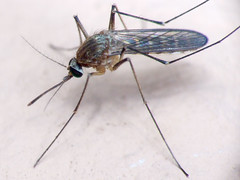
West Nile Virus is transmitted to humans by mosquitos, but is carried by birds. When dead birds are found in an area and examined for the virus, they tell epidemiologists that infection of local humans is likely.

We're used to associating mosquito proliferation with wet weather, but that's being proven a simplistic expectation. In California, the incidence of West Nile Virus is as high as it's ever been, while the state is experiencing the lowest precipitation since 1988. Scientists explain this by pointing to the fact that fewer watering holes means that more birds congregate in fewer locations, concentrating the population of carriers. Mosquitos find more targets in a smaller area, and consequently become more effective vectors to us humans.

This has been a dry year in California. The Sierra snowpack survey in May found that snow levels were 29 percent of normal, the lowest since 1988. In addition to crowding birds and mosquitoes, the drought is also reducing the natural flushing of urban storm drains, causing stagnant puddles that are ideal breeding grounds for Culex quinquefasciatus, a variety of mosquito linked to many West Nile outbreaks.
Even the real estate situation seems to have a hand in it. Homeowners facing higher payments or foreclosure and looking to save money will first quit maintaining their swimming pools, thus creating perfect algae-covered breeding grounds for more mosquitos.
In Kern County, half of all citizen complaints about mosquito swarms have been linked to neglected swimming pools that have turned green and become mosquito breeding sites.