Flood control requires an integrated understanding of hydrology and ecology of the Valvonti river basin. Controlling such floods in future needs joint monitoring and management of Valvonti’s inter-state catchments. There are natural and man-made reasons for the recent flash floods. Natural reasons may include higher rainfall intensity, bottlenecks in the silted streams feeding the tributaries and truncation of the normal flow channels. Man-made reasons could be several but the systematic destruction of the steep slopes of the Virdi hills by plantation owners in the catchment area of Valvonti is a major cause. The floods might have lasted for a few hours but the intensity and consequent damages were far greater this time than in the past. In Keri, Sattari such flash floods were experienced for the first time in 60 years, so the people were caught by surprise, especially as they took place in the night. The government thinks that longer, taller and stronger RCC embankments will control the floods. But these are of limited use if the flood water carries a heavy sediment load and acquires a higher momentum downstream. Embankments which fragment the natural flood plain could actually cause more havoc in the downstream areas.
Tuesday, October 2, 2007
Good article on flood control


Wednesday, August 15, 2007
Weather impacts today - Japan, N. Korea, Bangladesh, Sudan, Norway
Record high temps and an extended heatwave are "baking" Japan.
A relentless heatwave scorched Japan on Wednesday as temperatures hit record highs in many regions amid concerns of a possible power shortage in metropolitan Tokyo due to a shutdown of a key nuclear reactor. In Tatebayashi city, 70 km (44 miles) north of the capital, the temperature rose to 40.2 degrees Celsius (104 Fahrenheit), just below the historical high of 40.8 C marked in 1933, government's Meteorological Agency said.Estimated 300,000 homeless in North Korea after floods.
North Korea, which has suffered chronic food shortages for years, said hundreds were dead or missing after flooding over the past several days that washed away thousands of structures and ruined cropland in the country's agricultural bread basket. The North's official KCNA news agency quoted an agricultural ministry official as saying on Wednesday the damage to farm crops was heavier than in previous floods, with more than 11 percent of paddy and maize fields submerged, buried or swept away.Spreading illness marks aftermath of flooding in Bangladesh and Northeast India
More than 53,000 people have contracted diarrhoea in Bangladesh, mostly caused by eating stale food and drinking impure water. A field hospital has been opened in the capital, Dhaka, to treat diarrhoea patients. "The overall diarrhoea situation is grim. Everyday there is a rush of patients," said Ayesha Khatoon, a senior official at the government's health directorate. "We are trying to cope with it."Sudan's flooding has led to a cholera outbreak
The death toll from a cholera outbreak spread by devastating floods in east Sudan has risen to 53 with aFlooding is devastating parts of Norway
total of 763 cases identified, Sudanese health officials said on Wednesday. Sudan's health ministry is distributing chlorine to sterilise water, repairing latrines and spraying insecticides to try to stop the spread of cholera and malaria after the worst floods in living memory.

"This is completely unreal," said Ronald Havsten after watching his home sail down the Lauvnes river in Flatanger and head towards the sea.
***
Norwegian Water Resources and Energy Administration regional director Einar Sæterbø said that water levels in the region were well over so-called 'five-year flood' norms and were nearing 50-year flood levels, that is, flooding of a type seen only twice a century.
Monday, August 6, 2007
As the flood waters recede
In India and Bangladesh, the flooding displaced millions of people and killed hundreds.
More than 1,000 people have been killed or injured by rising waters, but aid agencies say the figure is expected to rise sharply.
U.N. children's body UNICEF said it had lost track of how many people had been affected by the floods across India, Pakistan, Bangladesh and Nepal.
So far about 20 million people are known to have fled their homes or trapped in villages at risk from landslides, snakebites and disease.
"Hundreds of thousands have lost their homes, their possessions, livestock and fields and will have to begin their lives from scratch when flood waters recede," UNICEF said.
The devastation comes on the heels of severe flooding in southern Pakistan, caused when Cyclone Yemyin struck the country's provinces of Balochistan and Sindh in late June.
Villagers are desperate for food, healthcare, medical supplies. Some are clashing with police.
Meanwhile in England, insurance companies have announced that premiums for next year will rise by 10 percent.Hospitals in eastern India were packed on Saturday with people suffering from waterborne diseases, and marooned villagers clashed with police as some of the worst floods in living memory ravaged South Asia.
More than 230 people have died over the past 11 days after torrential monsoon rains lashed the region, including much of Bangladesh, causing rivers to burst their banks. About 10 million people are homeless or cut off in their villages, with little or no access to food and health care. Health workers and aid groups in Assam in northeast India were working around the clock to treat and feed many of the 3 million people displaced or surrounded by flood waters in the state with the limited medicines and supplies available. Elsewhere, villagers were getting desperate and hungry.
Leading catastrophe-exposure modelling firm Risk Management Solutions has estimated the total cost to the insurance industry of this summer's flooding at 3.3 billion pounds.
Aviva, which owns Norwich Union, said on Thursday that the June and July floods -- brought about by the wettest summer since records began -- would cost it 340 million pounds and affect its general insurance results.
The firm said it expected a bill of 165 million pounds from the July floods, which badly hit central and western parts of England, on top of expected claims of 175 million pounds from the June floods.
It will take some time to evaluate which permanent changes are made by the countries affected by this summer's flooding. Southern Asia is accustomed to the annual monsoons, but this year's has been extreme and possibly an example of how monsoons of the future will behave.
Tuesday, July 17, 2007
India's Shrinking Glaciers
This quote from the New York Times science article (free subscription required) makes the case for reporting it in Climate Frog:
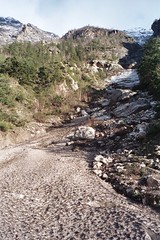
The thousands of glaciers studded across 1,500 miles of the Himalayas make up the savings account of South Asia’s water supply, feeding more than a dozen major rivers and sustaining a billion people downstream. Their apparent retreat threatens to bear heavily on everything from the region’s drinking water supply to agricultural production to disease and floods.The glaciers of the Himalaya, which feed the rivers that flow through India, are among the least studied glaciers in the world. There is little history of their growth and shrinkage to refer to in evaluating trends, but since all glaciers in all parts of the world have been in major retreat for the past 20 years, it's safe to assume that the same is true in the Himalaya. The difference here is that a huge population- over a billion people - is dependent on the water that has historically been released through the dry season by the gradual melting of these accumulations of ice.
As the article says, the IPCC addresses the shrinking glacier problem in its recently released report.
In its report, the international panel predicted that as these glaciers melt, they would increase the likelihood of flooding over the next three decades and then, as they recede, dry up the rivers that they feed. “In the course of the century,” it warned darkly, “water supply stored in glaciers and snow cover are projected to decline, reducing water availability in regions supplied by meltwater from major mountain ranges, where more than one-sixth of the world population currently lives.”